The Trestle Table Standard: Equipping a UK Finalist for In-Person Judging

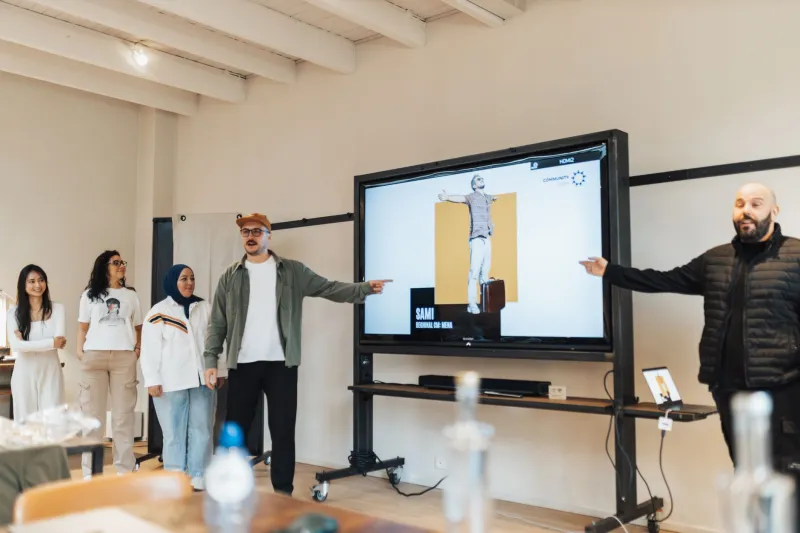
Photo: Jesse Dawson, CC BY-SA 4.0, via Wikimedia Commons
Most competition preparation rehearses the stage: the opening line, the timing, the slide that answers the obvious objection. That work matters. But a growing number of UK finals place the founder behind a trestle table in a crowded exhibition hall, with judges moving between stands and a programme that allows only a few minutes of attention. The table is not a lesser pitch. It is a different pitch, with its own failure modes and its own standards of preparation.
What the table asks of you
A stage pitch is a controlled sequence. A table conversation is an interruption-driven exchange. The judge may arrive mid-sentence, carrying a coffee and a scorecard, having just heard a competing claim two stands away. They may return later with a colleague. They may never return at all. The founder's task is therefore not to deliver a monologue but to make a small, legible operating environment that can be entered at any point.
That distinction should shape the kit. Anything that requires a clean start, a stable connection or a quiet room is a liability. Anything that allows a thirty-second reset is an asset.
The kit: power, connectivity, demonstration
The first principle is redundancy without clutter. A UK final held in a regional conference centre may offer reliable power, or it may offer a single socket shared across four stands. Bring a labelled power strip with a sensible cable length, a portable battery sufficient for a laptop and a phone, and charging cables for both. Do not rely on the venue's Wi-Fi for the core demonstration. If the product is software, carry a local build or a recorded walkthrough that runs without a network. If the product is hardware, carry a backup unit or a clear physical substitute, such as a non-functional model that can still be handled.
Connectivity deserves particular attention. A demonstration that depends on a live API, a cloud dashboard or a customer database is a demonstration that can fail in public. Decide in advance which single claim must be shown live and which can be shown through a prepared sequence. Label the prepared sequence honestly. Judges in the UK are accustomed to early-stage constraints; they are less forgiving of a founder who pretends a recorded clip is a live system.
The printed matter should be equally disciplined. A one-page summary with the company name, the problem, the current traction and a contact route is more useful than a glossy brochure. Keep it at A5 or A4, and keep a small number in a folder rather than scattered across the table. If the competition supplies a stand identifier or a judging number, display it prominently. Judges are often working to a map and a timetable; make yourself easy to locate.
Designing a demo for a crowded room
A crowded hall changes what can be seen and heard. Laptop speakers are inadequate. A small screen is inadequate. The demo should be designed for a judge standing at the edge of the table, possibly at an angle, possibly with another conversation happening nearby.
Use a larger external display if the venue permits it, and angle it towards the aisle rather than towards your own chair. Increase the interface scale before the event. Remove notifications, hide the desktop, and open only the screens that carry the argument. If the demonstration involves a physical object, place it where it can be picked up without knocking over a laptop. Practise the demonstration standing up, not seated, because that is how it will be delivered.
The strongest table demos are short and repeatable. A two-minute sequence that can be run six times in an afternoon is worth more than a twelve-minute tour that can be run twice. The founder should be able to start the sequence from any point and return to the beginning without apologising. That is not a theatrical skill; it is an operational one.
Turning footfall into a structured conversation
Judges do not arrive on a schedule you control. The temptation is to seize the first thirty seconds and deliver the whole story. A better approach is a short, repeatable opening that establishes category, stage and evidence, followed by a question that hands the conversation back.
A workable pattern is three sentences and a question: what the company does, who it serves, and the single most credible proof point. Then ask what the judge would find most useful to see. That question does two things. It respects the judge's limited time, and it reveals which part of the scorecard they are trying to fill. A judge who asks about unit economics should not be shown a brand video. A judge who asks about regulatory position should not be shown a product tour.
Avoiding the hijack
The table format rewards warmth, but it punishes monopolisation. If a judge is mid-conversation with another stand, do not intercept. If a judge is writing, wait. If a judge asks a question that invites a long answer, give the short answer first and offer the longer one as a follow-up. The founder who can say 'I can show you that in ninety seconds, or send the detail afterwards' is easier to score than the founder who cannot release the floor.
A simple handoff routine helps. Keep a notebook or a tablet with a prepared note-taking screen. Record the judge's name if it is visible, the question asked, and any follow-up promised. Do not attempt to collect business cards from everyone; collect them from the judges who ask a specific question. The aim is not maximum contacts but a clean record of the conversations that actually occurred.
What to leave behind
Leave behind the theatrical slide deck, the oversized banner that blocks the aisle, the noisy video loop, and the assumption that every judge will arrive at the same point in your story. Bring instead a table that can be understood in ten seconds, a demonstration that survives a bad connection, and a founder who can be interrupted without losing the thread. In a UK final, the table is not a waiting room before the real pitch. It is the pitch, and it rewards the same discipline: clarity, evidence and restraint.